


Last updated: 18 July 2026
The Short Answer
Choosing the right company director salary is one of the most common questions we’re asked by both new and established business owners. If you’re wondering how much you should pay yourself in 2026/27, you’re not alone.
The right company director salary depends on your business, your personal circumstances and your long-term goals.
The salary you take can affect far more than the money that arrives in your personal bank account each month. It influences your Income Tax, National Insurance, Corporation Tax, State Pension entitlement and the amount of profit available to withdraw as dividends. It can even affect mortgage applications and your company’s future cash flow.
For many owner-managed limited companies, the most tax-efficient approach is a combination of salary and dividends. However, the right balance depends on your company’s profits, your personal circumstances and your long-term financial goals.
In this guide, we’ll explain how director remuneration works, compare salaries and dividends, look at the tax implications, highlight common mistakes and show you how to decide on the most appropriate remuneration strategy for your business.
Whether you’re starting your first limited company or reviewing your existing remuneration, this guide will help you make a more informed decision.
There is no single “correct” salary for every company director.
The most tax-efficient remuneration strategy depends on several factors, including:
- Your company’s expected profits.
- Whether you qualify for Employment Allowance.
- Any other taxable income you receive.
- Your pension planning.
- Whether you intend to take dividends.
- Your future personal and business goals.
For that reason, your salary should normally be reviewed every tax year rather than simply leaving it unchanged.
Key Takeaways
If you only remember five things from this guide, make them these:
- There isn’t one perfect salary.
- Most directors benefit from a combination of salary and dividends.
- Your salary affects Income Tax, National Insurance, Corporation Tax and your State Pension entitlement.
- Paying the lowest possible salary isn’t always the most tax-efficient option.
- Review your remuneration every tax year.
Table of Contents
Introduction
One of the first questions almost every company director asks is:
“How much should I pay myself?”
It’s a simple question, but the answer depends on far more than the current tax thresholds.
Unlike a sole trader, a limited company is a separate legal entity. That means you can’t simply withdraw money whenever you like without considering how it’s is treated for tax and accounting purposes.
The way you pay yourself can affect:
- Your personal Income Tax and National Insurance.
- Your company’s Corporation Tax bill.
- Your entitlement to the State Pension.
- The amount available to distribute as dividends.
- Your ability to obtain a mortgage or other borrowing.
- Your company’s cash flow and future growth plans.
At Smart Accountants Sussex & Surrey, we work with company directors across Dorking, Leatherhead, Reigate, Redhill, Epsom, Tadworth, Horley, Worthing and the surrounding areas. Rather than recommending a generic figure, we look at both the company’s financial position and the director’s personal objectives before providing advice.
Throughout the rest of this guide, we’ll explain how salaries, dividends, National Insurance and Corporation Tax work together, helping you understand not just how much salary you should take, but why that amount is right for your circumstances.
1. Why Your Director’s Salary Matters
One of the first questions almost every company director asks is:
“How much should I pay myself?”
It’s a simple question, but the answer depends on far more than the current tax thresholds.
Unlike a sole trader, a limited company is a separate legal entity. That means you can’t simply withdraw money whenever you like without considering how it’s is treated for tax and accounting purposes.
The way you pay yourself can affect:
- Your personal Income Tax and National Insurance.
- Your company’s Corporation Tax bill.
- Your entitlement to the State Pension.
- The amount available to distribute as dividends.
- Your ability to obtain a mortgage or other borrowing.
- Your company’s cash flow and future growth plans.
At Smart Accountants Sussex & Surrey, we work with company directors across Dorking, Leatherhead, Reigate, Redhill, Epsom, Tadworth, Horley, Worthing and the surrounding areas. Rather than recommending a generic figure, we look at both the company’s financial position and the director’s personal objectives before providing advice.
Throughout the rest of this guide, we’ll explain how salaries, dividends, National Insurance and Corporation Tax work together, helping you understand not just how much salary you should take, but why that amount is right for your circumstances.
2. Salary vs Dividends – What’s the Difference?
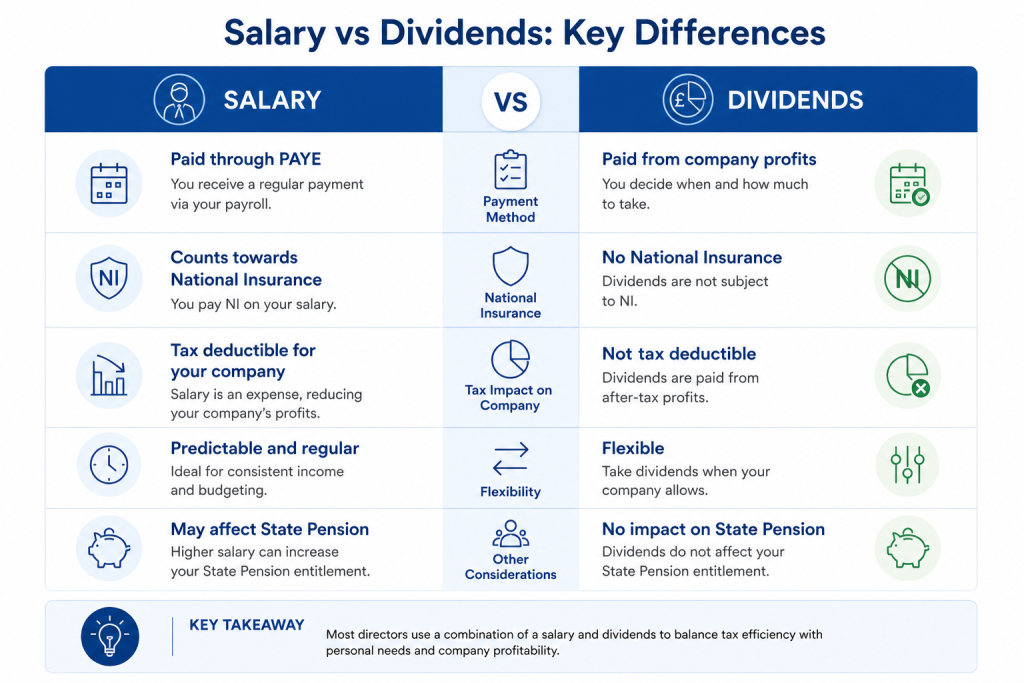
As a company director, there are two main ways you can take money out of your limited company:
- Salary, which is paid through payroll.
- Dividends, which are paid from the company’s profits.
For many owner-managed businesses, the most tax-efficient approach is a combination of both. However, they work very differently, and understanding those differences is key to making informed decisions.
What Is a Salary?
A salary is paid to you as an employee of your company through PAYE (Pay As You Earn).
Even if you own 100% of the business, you can still be employed by your own company and receive a salary.
A salary:
- Is processed through payroll.
- May be subject to Income Tax and National Insurance.
- Is usually an allowable business expense, meaning it can reduce your company’s Corporation Tax bill.
- May help build qualifying years towards your State Pension.
Many directors choose to pay themselves a regular monthly salary because it provides a predictable income while also supporting their wider tax planning.
What Is a Dividend?
A dividend is a payment made to shareholders from the company’s profits.
Unlike a salary, you receive a dividend because you own shares in the business, not because you work for it.
Before a dividend can be paid, the company must have sufficient distributable profits available.
Dividends:
- Are not processed through payroll.
- Do not attract National Insurance.
- Do not reduce your company’s Corporation Tax bill.
- Must be properly declared and recorded.
| Salary | Dividends |
|---|---|
| Paid through payroll | Paid from company profits |
| Usually reduces Corporation Tax | Does not reduce Corporation Tax |
| May attract Income Tax and National Insurance | No National Insurance (although Dividend Tax may apply) |
| Can build National Insurance credits | Does not build National Insurance credits |
| Requires payroll reporting | Requires dividend paperwork and sufficient distributable profits |
Why Most Company Directors Use Both
Many new business owners assume they should take either a salary or dividends.
In reality, that’s rarely the most effective approach.
A carefully planned salary can reduce your company’s taxable profits while helping protect your National Insurance record.
Dividends can then be used to withdraw additional profits without creating further National Insurance liabilities.
The objective isn’t to choose one instead of the other—it’s to find the right balance for your individual circumstances.
A Practical Example
Imagine two company directors whose businesses generate exactly the same annual profit.
Director A takes everything as dividends.
Director B takes a modest salary through payroll before withdrawing the remaining profits as dividends.
At first glance, Director A may appear to pay less tax personally.
However, once Corporation Tax, National Insurance and the company’s overall tax position are taken into account, Director B may actually be better off overall.
This illustrates one of the most important principles of remuneration planning:
The aim isn’t to minimise one tax. It’s to minimise the combined tax paid by both you and your company.
Your remuneration should always be considered alongside your Limited Company Accounts and Corporation Tax position.
Don’t Look at Salary in Isolation
Your salary is just one part of your overall remuneration strategy.
The most appropriate balance between salary and dividends depends on several factors, including your company’s profitability, your personal income, pension planning and future financial goals.
If you’d like to understand how company profits are calculated before Corporation Tax, you may also find our guide to Limited Company Tax Returns (CT600) helpful.
If your business operates within the construction industry, our guide to the Construction Industry Scheme (CIS) explains the additional tax rules that contractors and subcontractors need to consider.
3. National Insurance and Corporation Tax Explained
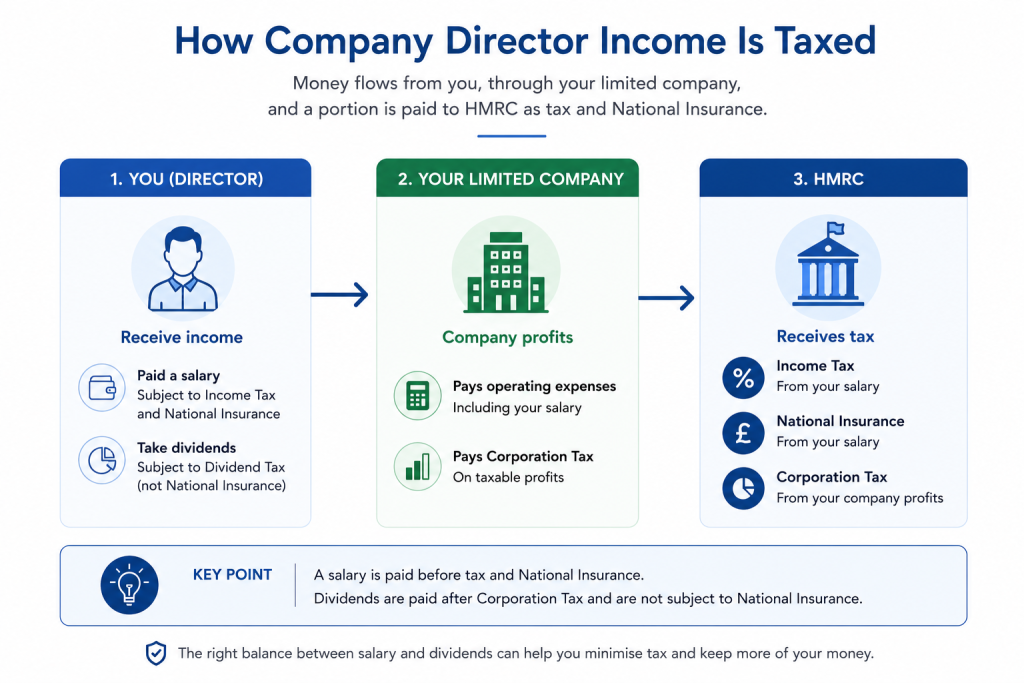
Once you understand the difference between salaries and dividends, the next question is usually:
“So, how much salary should I actually take?”
The answer depends on more than just Income Tax.
Your salary also affects National Insurance, your company’s Corporation Tax bill and, in some cases, your future State Pension entitlement.
Rather than looking at each tax individually, it’s important to understand how they work together.
Why Tax Isn’t the Whole Story
Most people are familiar with Income Tax.
As your salary increases, the amount of Income Tax you pay may also increase once your available tax-free allowances have been used.
However, Income Tax is only one part of the calculation.
A salary that reduces your personal Income Tax bill isn’t necessarily the most tax-efficient outcome once National Insurance and Corporation Tax are taken into account.
National Insurance
National Insurance is often where company directors become confused.
Depending on the level of your salary, it may affect:
- Your entitlement to the UK State Pension.
- Whether employee National Insurance becomes payable.
- Whether your company pays Employer National Insurance.
- Whether Employment Allowance can be used.
This is why two company directors with very similar businesses can have completely different remuneration strategies.
You can find further information about National Insurance credits on the GOV.UK website.
Corporation Tax
Unlike dividends, salaries are generally an allowable business expense. This means your remuneration should be considered alongside your limited company accounts, as both have a direct impact on your company’s overall tax position.
That means paying a salary will usually reduce your company’s taxable profits before Corporation Tax is calculated.
Dividends work differently.
Because they are paid from profits after Corporation Tax has been calculated, they don’t reduce your company’s Corporation Tax bill.
Looking only at your personal tax position can therefore be misleading.
The most tax-efficient solution is usually the one that minimises the combined tax paid by both you and your company.
Further guidance on Corporation Tax is available on the GOV.UK website.
There isn’t one “perfect” salary. The right remuneration strategy minimises the combined tax paid by both you and your company, while also supporting your long-term financial goals.
Why There Isn’t a Perfect Salary
Many websites suggest there is one “correct” salary for every company director.
Unfortunately, it isn’t that simple.
The right salary depends on factors such as:
- Your company’s expected profits.
- Whether you have other employment or taxable income.
- Whether your company qualifies for Employment Allowance.
- Planned dividend payments.
- Pension contributions.
- Mortgage plans.
- Your wider personal and business goals.
This is why professional accountants don’t recommend exactly the same salary for every client.
Instead, they review each director’s circumstances before deciding on the most appropriate remuneration strategy.
Review Your Salary Every Year
A remuneration strategy shouldn’t be set once and forgotten.
Tax legislation changes.
Businesses grow.
Personal circumstances evolve.
Reviewing your salary each tax year helps ensure you’re still paying yourself in the most appropriate way while making the most of the available tax reliefs.
4. Choosing the Right Company Director Salary
By now, you’ve probably realised there isn’t a single salary that’s right for every company director.
If there were, every accountant would recommend exactly the same figure.
Instead, the most appropriate remuneration strategy depends on your business, your personal circumstances and your future plans.
When we advise clients, we don’t start by asking:
“How much do you want to pay yourself?”
Instead, we ask questions such as:
- How profitable is the business?
- Do you have any other income?
- Will you also be taking dividends?
- Are you planning to apply for a mortgage?
- Do you want to maximise pension contributions?
- Are you planning to leave profits in the company?
The answers to those questions help determine the most appropriate remuneration strategy.
Here are some common examples.
Starting Your First Limited Company
If you’re the sole director and shareholder of a new limited company, a combination of salary and dividends is often worth considering.
A carefully planned salary may:
- Reduce your company’s Corporation Tax bill.
- Help build qualifying National Insurance years.
- Provide a regular monthly income.
As the business grows and becomes more profitable, dividends can then be used to withdraw additional profits tax-efficiently.
Already Have Another Job?
Your remuneration strategy may be very different if you already receive a salary from another employer.
Your Personal Allowance, Income Tax bands and National Insurance position may already be affected by your existing employment.
Rather than looking at your limited company in isolation, it’s important to consider your overall income before deciding how much salary to take.
Running the Business With Your Spouse or Partner
Many family businesses are owned jointly.
Where both individuals genuinely work in the business, there may be opportunities to structure remuneration more efficiently by considering salaries, dividends and each person’s available tax allowances.
The right approach will depend on your company’s ownership structure and your family’s wider financial position.
When Your Business Starts Growing
A remuneration strategy that worked when your business first started may not remain appropriate as profits increase.
Growing businesses often benefit from reviewing:
- Salary levels.
- Dividend strategy.
- Pension contributions.
- Future investment plans.
- Cash flow requirements.
Reviewing your remuneration annually helps ensure it continues to support both your business and your personal financial goals.
If Profits Fall
Not every year goes according to plan.
If profits are lower than expected, your remuneration strategy may also need to change.
For example, there may be fewer profits available for dividends, or preserving cash within the business may become a greater priority.
Good remuneration planning isn’t just about reducing tax—it’s about supporting the long-term stability of your business.
Planning to Buy a Home?
Tax isn’t always the only consideration.
If you’re planning to apply for a mortgage, your remuneration strategy could affect how lenders assess your income.
Some lenders place greater emphasis on salary, while others also consider dividends and company profits.
If buying a property is one of your short-term goals, it’s worth reviewing your remuneration before submitting a mortgage application.
Every Director Is Different
These examples demonstrate why there is no universal salary that works for every company director.
Two businesses with identical profits may still require completely different remuneration strategies because the directors have different goals, different income and different personal circumstances.
The best remuneration strategy isn’t simply the one that produces the lowest tax bill.
It’s the one that supports your business, your personal finances and your long-term objectives.
Worked Example
Let’s look at a simple example of how a typical remuneration strategy might work in practice.
Imagine your limited company expects to make £60,000 profit before paying you, and you have no other employment or taxable income.
For many sole directors during the 2026/27 tax year, a salary of £12,570 is often a sensible starting point. This makes full use of your Personal Allowance, provides a qualifying year towards your State Pension and, in many cases, reduces your company’s Corporation Tax liability.
The remaining profits can then be taken as dividends, provided the company has sufficient distributable profits after paying Corporation Tax.
This combination of salary and dividends often provides a more tax-efficient outcome than taking all of your income as salary.
This approach may help you:
- Make full use of your available tax allowances.
- Reduce your company’s Corporation Tax liability.
- Receive a qualifying year towards your State Pension.
- Withdraw profits in a tax-efficient manner.
Important: This example is provided for general guidance only. The most tax-efficient remuneration strategy depends on your individual circumstances, including your company’s profits, other sources of income, pension contributions, the number of directors and whether your company qualifies for Employment Allowance.
The most tax-efficient salary isn’t necessarily the lowest salary. It’s the salary that works best alongside your dividends, tax position and long-term plans.
5. Five Questions to Ask Before Deciding Your Salary
Before deciding how much salary to take from your limited company, it’s worth taking a step back.
Rather than focusing solely on tax, ask yourself these five questions.
A few minutes spent considering them could help you avoid costly mistakes and ensure your remuneration supports both your personal finances and your business.
1. What Are My Financial Goals?
Are you trying to maximise your take-home income, save for retirement, apply for a mortgage or leave more money in the business?
Your objectives should influence how you pay yourself.
A remuneration strategy that works well for one director may be completely unsuitable for another.
2. Is My Business Performing as Expected?
Your remuneration should reflect your company’s financial position.
If profits are significantly higher or lower than expected, it may be sensible to review your salary and dividend strategy rather than simply repeating last year’s figures.
3. Do I Have Any Other Sources of Income?
If you already receive income from employment, rental properties, investments or another business, this could affect the most tax-efficient way to pay yourself.
Always consider your overall tax position rather than looking at your limited company in isolation.
4. Am I Thinking Beyond This Year’s Tax Bill?
Reducing tax is important, but it shouldn’t be the only objective.
A good remuneration strategy should also consider:
- Future pension entitlement.
- Cash flow.
- Business growth.
- Mortgage applications.
- Long-term financial planning.
Sometimes paying slightly more tax today can produce a better financial outcome in the future.
5. Have I Reviewed My Remuneration Recently?
Many directors continue using the same remuneration strategy for years without reviewing it.
However, businesses evolve, tax legislation changes and personal circumstances rarely stay the same.
Reviewing your remuneration each tax year helps ensure it continues to meet both your business needs and your personal financial goals.
A five-minute review each year can often save significantly more than it costs in unnecessary tax or missed planning opportunities.
A Simple Checklist
Before deciding how much salary to take, ask yourself:
- Is my business making sufficient profits?
- Do I have any other taxable income?
- Am I planning to take dividends?
- Will my remuneration affect future mortgage applications?
- Have I reviewed my salary during the current tax year?
If you’re unsure about any of these questions, it’s usually worth seeking professional advice before making changes.
6. Common Mistakes Company Directors Make
Even with the best intentions, it’s easy for company directors to make mistakes when deciding how to pay themselves.
Fortunately, most of these issues are straightforward to avoid once you understand the rules and review your remuneration regularly.
Here are some of the most common mistakes we see.
1. Never Reviewing Your Salary
Many directors decide on a salary when they first start trading and then leave it unchanged for years.
During that time, tax legislation, business profits and personal circumstances can all change.
Reviewing your remuneration each tax year helps ensure you’re still paying yourself in the most appropriate way.
2. Copying Someone Else’s Remuneration
It’s common to hear advice such as:
“My accountant told me to take £X, so you should too.”
Unfortunately, remuneration isn’t one-size-fits-all.
A strategy that works well for another business owner may not be suitable for your circumstances.
3. Paying Dividends Without Checking Profits
Dividends can only be paid if your company has sufficient distributable profits.
Taking dividends without understanding your company’s financial position can create unnecessary tax and accounting issues.
Keeping accurate bookkeeping and reviewing your figures regularly helps avoid this problem.
4. Mixing Business and Personal Finances
Treating the company bank account as your personal bank account often leads to unnecessary complications.
Keeping business and personal finances separate makes bookkeeping easier and helps ensure transactions are recorded correctly.
5. Focusing Only on Paying Less Tax
Reducing tax is important, but it shouldn’t be the only objective.
Your remuneration strategy should also consider:
- Your State Pension entitlement.
- Cash flow.
- Mortgage applications.
- Future business growth.
- Long-term financial planning.
The lowest tax bill doesn’t always produce the best overall outcome.
Avoiding These Mistakes
Most remuneration mistakes aren’t caused by misunderstanding the rules.
They’re caused by never reviewing them.
A short annual review can often identify opportunities to improve tax efficiency while ensuring your remuneration continues to support your business and personal goals.
7. How We Help Company Directors Decide Their Salary
By now, you’ve probably realised that deciding how much salary to take isn’t simply a case of picking a figure from a tax table.
The right remuneration strategy depends on your business, your personal circumstances and your plans for the future.
That’s why we never recommend exactly the same approach for every client.
Our Approach
When we review a company director’s remuneration, we don’t start with tax thresholds.
We start by understanding you and your business.
Typically, we’ll discuss:
- Your expected company profits.
- Whether you have any other income.
- Your plans for taking dividends.
- Your Corporation Tax position.
- National Insurance thresholds and State Pension entitlement.
- Pension contributions.
- Whether you’re planning to apply for a mortgage or other borrowing.
- Your cash flow requirements.
- Whether you intend to leave profits in the company for future growth.
Only after looking at the complete picture do we recommend the most appropriate remuneration strategy.
Proactive, Not Reactive
Many accountants only discuss director salaries once the year-end accounts have been prepared.
By that stage, many planning opportunities have already passed.
We believe remuneration should be reviewed throughout the year, particularly if:
- Your profits are significantly different from expected.
- Tax legislation changes.
- Your personal circumstances change.
- You’re planning a major purchase or mortgage application.
- Your business starts growing rapidly.
Reviewing your remuneration before the tax year ends gives you more flexibility and allows changes to be made while there’s still time to benefit.
Practical Advice You Can Understand
Tax legislation can be complicated.
Our job is to make it straightforward.
Rather than overwhelming you with technical jargon, we’ll explain your options in plain English, outline the advantages and disadvantages of each approach and help you understand why we’re making a particular recommendation.
The result is a remuneration strategy that’s not only tax-efficient, but also supports your wider business and personal goals.
If you’re unsure whether you’re taking the right salary, or you’d simply like a second opinion, we’d be happy to review your current remuneration and discuss the options available.
8. Frequently Asked Questions
What is the most tax-efficient salary for a company director?
There isn’t a single salary that’s right for every company director.
The most tax-efficient approach depends on your company’s profitability, your personal income, whether you qualify for Employment Allowance and whether you also plan to take dividends. For many owner-managed businesses, a combination of salary and dividends provides the best overall outcome.
Can I pay myself only in dividends?
You can, but it isn’t always the most tax-efficient option.
Dividends don’t attract National Insurance, but they can only be paid if your company has sufficient distributable profits. Taking no salary at all may also affect your National Insurance record and future State Pension entitlement.
GOV.UK also provides guidance on how dividends are taxed.
Does a salary reduce Corporation Tax?
Generally, yes.
A salary is usually an allowable business expense, meaning it reduces your company’s taxable profits before Corporation Tax is calculated. Dividends are paid from profits after Corporation Tax and therefore don’t provide the same tax relief.
Can I change my salary during the tax year?
Yes.
Many company directors review their remuneration during the year if profits, tax legislation or their personal circumstances change. Regular reviews provide more flexibility than waiting until the year-end accounts have been prepared.
Do I need to run payroll if I’m the only director?
In many cases, yes.
Even if you’re the company’s only employee, operating payroll correctly ensures your salary is reported to HMRC and helps maintain accurate tax records.
If you’d rather not deal with RTI submissions yourself, our Payroll Services can take care of everything for you.
Can my spouse or civil partner also receive income from the company?
Potentially.
If they genuinely work in the business, a commercial salary may be appropriate. If they’re also a shareholder, they may receive dividends. The most suitable approach depends on your company’s ownership structure and your family’s overall tax position.
How often should I review my salary?
We recommend reviewing your remuneration at least once each tax year.
You should also consider a review if your profits change significantly, your personal circumstances change or you’re planning a major financial commitment such as a mortgage application.
Do I need an accountant to decide my salary?
No, but professional advice can help you make informed decisions.
Your remuneration affects Income Tax, National Insurance, Corporation Tax, dividends and your long-term financial planning. A tailored review can often identify opportunities that generic online advice simply can’t.
Final Thoughts
Hopefully, this guide has shown that deciding how much salary to take is about much more than simply choosing a number.
The most appropriate remuneration strategy depends on your company’s profitability, your personal circumstances and your long-term financial goals. While many owner-managed limited companies benefit from a combination of salary and dividends, the right balance should always be based on your individual situation.
Reviewing your remuneration regularly can help you:
- Make the most of available tax reliefs.
- Avoid unnecessary tax.
- Build a sustainable remuneration strategy.
- Support your long-term business and personal financial goals.
At Smart Accountants Sussex & Surrey, we help company directors across Surrey and Sussex review their remuneration throughout the year, ensuring they’re paying themselves in a way that supports both their business and their future plans.
If you’d like tailored advice or simply want reassurance that you’re taking the right salary, we’d be delighted to help.

Contact us today to book your free, no-obligation consultation and make sure you’re paying yourself in the most tax-efficient way for your circumstances.