
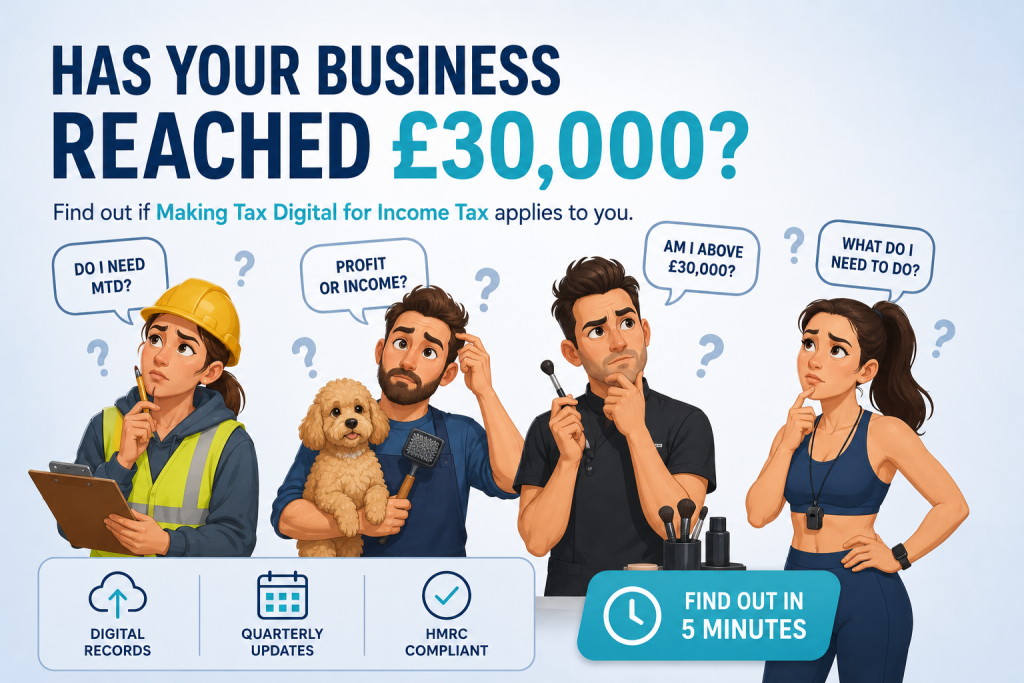
Has your business recently gone over £30,000?
Firstly, congratulations. Reaching this level of income is a significant milestone for any growing business.
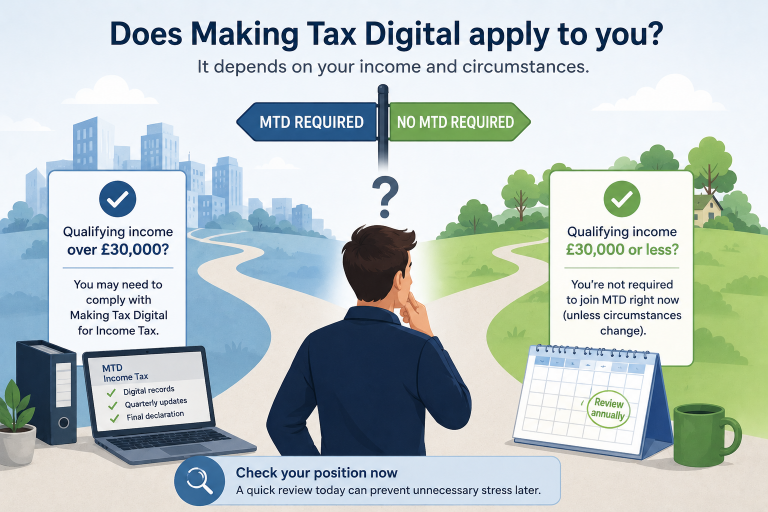
If your qualifying income for the 2025/26 tax year is over £30,000, you’ll generally need to start using Making Tax Digital (MTD) for Income Tax from 6 April 2027. This means keeping digital records and sending quarterly updates to HMRC using compatible accounting software.
If you’d like a broader overview of the new reporting requirements, take a look at our Making Tax Digital for Income Tax guide.
Whether you’re a builder, beautician, electrician, plumber, dog groomer or any other self-employed tradesperson, professional or business owner in Dorking, Leatherhead or the surrounding Surrey and Sussex area, understanding what’s changing now will make the transition much easier.
At Smart Accountants Sussex & Surrey, we’ve seen a noticeable increase in sole traders asking about Making Tax Digital over the past year. One question comes up more than any other:
“Do I need Making Tax Digital?”
Fortunately, it’s usually a straightforward question to answer once we’ve reviewed a client’s latest Self Assessment tax return.
If you’re unsure whether Making Tax Digital applies to you, get in touch with us and we’ll be happy to review your position.
You can also check HMRC’s official guidance on whether Making Tax Digital applies to you.
What is the £30,000 MTD threshold?
One of the biggest misconceptions we come across is that Making Tax Digital is based on profit.
It isn’t.
HMRC looks primarily at your qualifying income, which generally includes your gross self-employment income and UK property income before expenses, based on your latest Self Assessment tax return.
HMRC also explains how qualifying income is calculated and who is affected.
This often surprises new clients. We’ve spoken to many business owners who assumed they were outside Making Tax Digital because their profit was below £30,000, only to discover that their income was above HMRC’s entry point.
If you receive both self-employment income and rental income, HMRC may combine these when deciding whether you’ll need to join the new system.
As a general guide:
Qualifying income Likely position*
Qualifying income | Likely position* |
£18,000 | Not currently within MTD for Income Tax |
£25,000 | Generally expected in scope from 6 April 2028 |
£35,000 | Generally in scope from 6 April 2027 |
£60,000 | Generally within MTD from 6 April 2026 |
*Based on HMRC’s current timetable. Individual circumstances and exemptions may apply.
A real example
One client, a personal trainer, contacted us after their business income fell from around £60,000 in 2024/25 to approximately £35,000 in 2025/26. They assumed that because their income had reduced, they would no longer need to use Making Tax Digital.
However, as their 2024/25 qualifying income exceeded £50,000, they were already required to join Making Tax Digital from 6 April 2026. A reduction in income the following year didn’t automatically remove that obligation.
It’s a good example of why it’s important not to make assumptions. A quick review of your Self Assessment tax returns can often identify whether Making Tax Digital applies and prevent unexpected surprises later.
If you’re wondering “How do I know if my income is over £30,000?”, don’t panic. In most cases, we can answer that by reviewing your latest Self Assessment tax return. Clients are often surprised how quickly we can establish whether they’ll fall within the new reporting requirements.
Every business is different. If you’d like us to review your latest Self Assessment tax return, contact our team for straightforward advice.
Does Making Tax Digital apply to all sole traders?
Not necessarily.
Whether you’ll need to comply depends primarily on your qualifying income and whether any exemptions apply.
Many sole traders won’t need to join immediately, while others may already fall within HMRC’s timetable. That’s why it’s worth checking your position now rather than waiting until the deadline approaches.
A quick review today can prevent unnecessary stress later.
My business has gone over £30,000. What happens now?
The good news is that Making Tax Digital doesn’t change when you pay your tax.
Instead, it changes how information is recorded and reported to HMRC.
Rather than preparing your bookkeeping once a year, you’ll keep digital records throughout the year and submit quarterly updates using HMRC-compatible software.
For most sole traders, this means:
- Keeping digital accounting records.
- Recording income and expenses throughout the year.
- Sending quarterly updates to HMRC.
- Completing a Final Declaration after the end of the tax year.
Your normal Self Assessment payment dates remain exactly the same.
One of the biggest myths we hear is that tax will need to be paid every three months. Thankfully, that isn’t the case. Quarterly updates are simply another way of reporting information to HMRC.
Do builders, beauticians and other sole traders need Making Tax Digital?
In most cases, yes, if your income is above HMRC’s current entry point.
The same test applies whether you’re a builder, electrician, beautician, dog groomer, consultant, photographer, marketing professional or any other sole trader.
One thing we’ve noticed is that businesses already using cloud accounting software often adapt quickly, while those relying on paper records or spreadsheets usually benefit from moving to digital bookkeeping well before the deadline.
Giving yourself a few months to become familiar with the software makes the transition much less stressful than leaving everything until the last minute.
It’s also worth reviewing your business before your year end, as this gives you time to identify tax-saving opportunities and prepare for upcoming changes. Our guide to a pre-year-end review explains what to check before your accounts are finalised.
Making Tax Digital is only one part of running a tax-efficient business. If you’re self-employed, you may also find our guide on tax tips for sole traders useful, covering practical ways to stay organised and avoid paying more tax than necessary.
Do I need accounting software?
For most businesses, yes.
You’ll need software that can maintain digital records and submit information directly to HMRC.
Many of our clients choose Xero, while others prefer LimeBooks, particularly if they’re looking for a straightforward and cost-effective solution.
A question we’re often asked is “Can I still use spreadsheets?” The answer depends on whether your records meet HMRC’s Making Tax Digital requirements and how they’re used alongside compatible software. For many sole traders, dedicated bookkeeping software is the simplest and most reliable option.
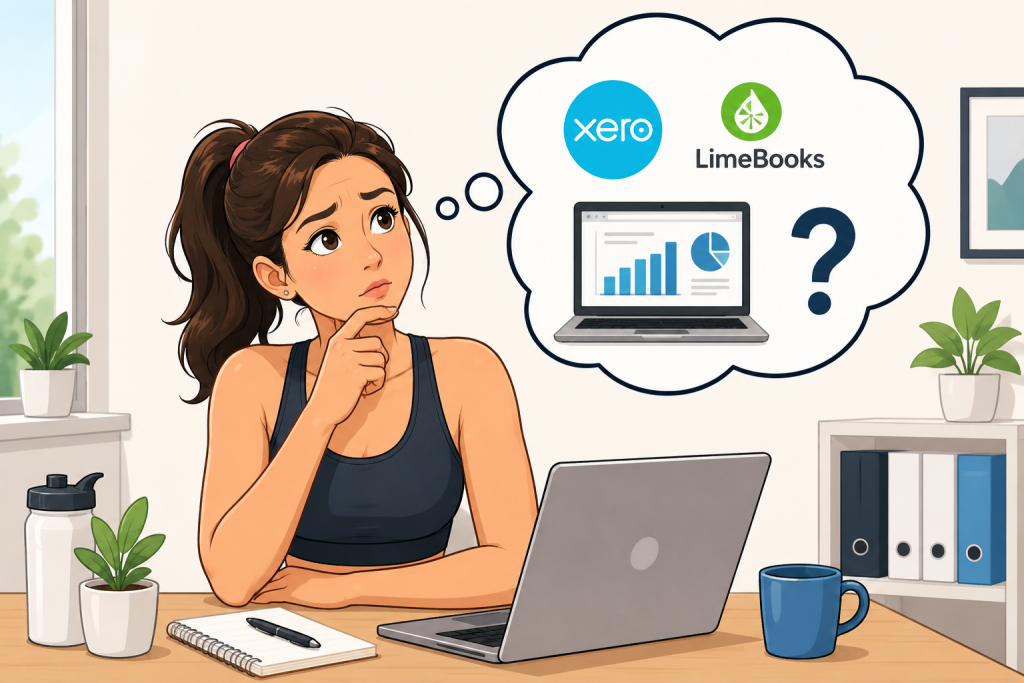
The most important thing isn’t choosing the “perfect” software. It’s choosing one you’ll use consistently and keeping your bookkeeping up to date throughout the year.
If you’re unsure which package is right for your business, we’re always happy to explain the options and recommend the most suitable solution based on the way you work.
Not sure whether Xero, LimeBooks or another package is right for you? Speak to us today and we’ll recommend the best option for your business.
We also provide a range of accountancy and bookkeeping services to help sole traders prepare for Making Tax Digital and stay compliant as their business grows.
The three biggest mistakes we see
As more sole traders prepare for Making Tax Digital, we’ve noticed the same misunderstandings cropping up time and time again.
1. Assuming it's based on profit
Almost every week we speak to business owners who believe they’re outside Making Tax Digital because their profit is below £30,000. However, HMRC generally looks at your qualifying income, not the profit left after deducting expenses.
It’s often a five-minute conversation that completely changes a client’s understanding of whether they’ll need to comply.
2. Forgetting about rental income
If you’re self-employed and also receive income from UK property, both sources may be considered when deciding whether Making Tax Digital applies.
We’ve had several clients who were surprised to discover that their rental income could bring them within the new reporting requirements.
3. Leaving bookkeeping until the last minute
The businesses that make the smoothest transition are usually those that prepare well in advance.
Choosing suitable software, learning how it works and developing good bookkeeping habits takes time. Starting early removes much of the pressure and usually makes running your business easier throughout the year.
FAQs
Is the £30,000 MTD threshold based on turnover or profit?
Neither exactly.
HMRC generally looks at your qualifying income, which is usually your gross self-employment and UK property income before expenses. It isn’t based on the taxable profit shown in your accounts.
How do I know if my income is over £30,000?
The easiest way is to review your latest Self Assessment tax return.
If you’re unsure which figure HMRC uses, don’t worry. We can normally confirm whether you’ll be within Making Tax Digital in just a few minutes.
My business has gone over £30,000. Do I need Making Tax Digital?
If your qualifying income for the relevant tax year exceeds HMRC’s entry point, you’ll generally need to start using Making Tax Digital from 6 April 2027, unless an exemption applies.
If you’re unsure, it’s worth checking now rather than waiting until the deadline approaches.
Does rental income count?
It can.
If you receive income from both self-employment and UK property, HMRC may consider the combined figure when deciding whether you’ll need to join Making Tax Digital.
Will I pay tax every three months?
No.
This is one of the biggest myths surrounding Making Tax Digital.
Quarterly submissions are simply updates sent to HMRC. They don’t normally change your existing Self Assessment payment dates.
Can I still use spreadsheets?
Possibly, but they must meet HMRC’s Making Tax Digital requirements.
Many businesses find dedicated bookkeeping software such as Xero or LimeBooks to be a simpler and more reliable solution, particularly as their business grows.
What happens if I don't comply?
If you’re required to use Making Tax Digital and fail to meet your obligations, HMRC may charge penalties or take compliance action.
Preparing early gives you plenty of time to understand the new requirements and avoid unnecessary problems.
Do I have to use Xero?
No.
Xero is one of several HMRC-compatible software packages available. Some businesses prefer LimeBooks or another compatible solution.
The best software is the one that suits your business and that you’ll use consistently.
Are partnerships included?
Not currently.
At the time of writing, general partnerships are not yet within Making Tax Digital for Income Tax, although HMRC may extend the regime in the future.
If you’re unsure how your business structure affects your obligations, we’d be happy to advise
Can I claim an exemption from Making Tax Digital?
Yes, possibly. Most people who are exempt fall into one of two groups: those who are digitally excluded and those who qualify for a specific HMRC exemption. If you think that might apply to you, it’s worth getting advice so you don’t worry unnecessarily.
Need help understanding the £30,000 MTD threshold?
If your business has recently grown, or you think your income may be approaching HMRC’s entry point for Making Tax Digital, now is the ideal time to start preparing.
From our office in Dorking, we help sole traders across Surrey and Sussex understand whether they’ll be affected, improve their bookkeeping and choose the right accounting software before the new reporting requirements begin.
Whether you’re a builder, consultant, beautician, photographer or any other sole trader, we’ll explain everything in plain English and help you prepare with confidence.
If you’d like straightforward, practical advice without the jargon, contact Smart Accountants Sussex & Surrey to arrange a free initial conversation about Making Tax Digital and your business.
If you’d like to read the official legislation and guidance, HMRC has published detailed information on Making Tax Digital for Income Tax.
If you’ve only recently become self-employed, our new business starter guide covers the key accounting, tax and bookkeeping steps to help you get everything right from day one.
Last reviewed against HMRC guidance: July 2026
Want to know more about the team behind Smart Accountants Sussex & Surrey? You can learn more about us and how we support businesses across Surrey and Sussex.