

Published: 2 August 2026
Last Updated: 2 August 2026
Updated for the 2026/27 Tax Year
This guide has been reviewed for the 2026/27 tax year and reflects the current company tax rules, including:
✔ Corporation Tax rates
✔ Marginal Relief
✔ Associated company rules
✔ Quarterly Installment Payments
✔ Corporation Tax payment deadlines
Understand exactly how much Corporation Tax your limited company is likely to pay
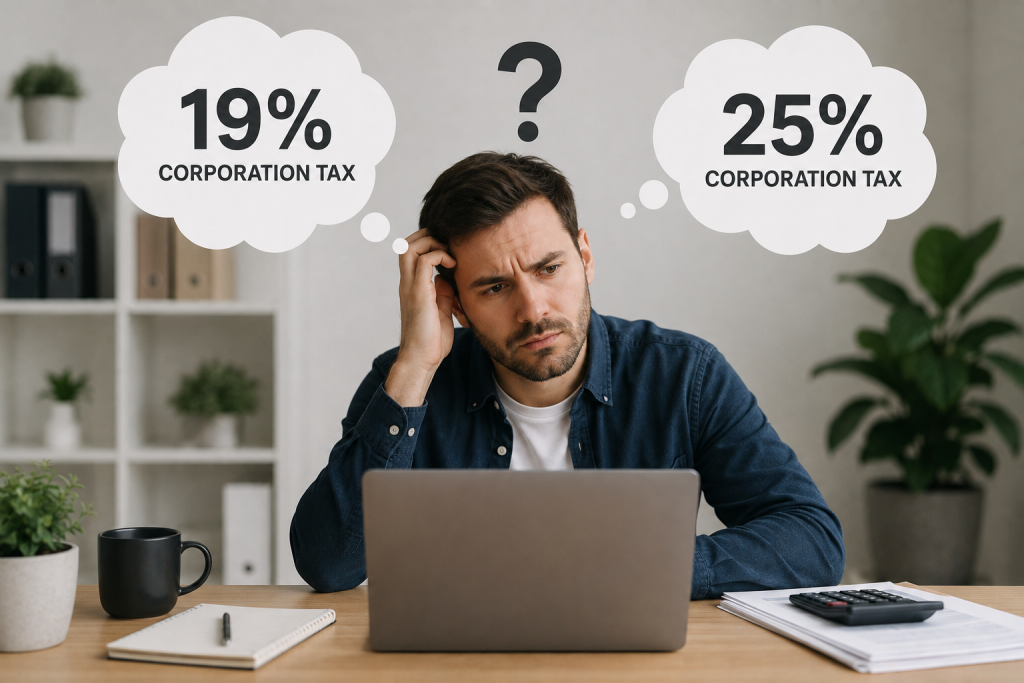
Wondering whether your company will pay Corporation Tax at 19% or 25%?
The answer depends on more than just your profits.
Your company’s tax rate can also be affected by Marginal Relief, associated companies, your accounting period and, in some cases, when you pay yourself as a director.
This guide explains everything you need to know in straightforward English, helping you understand how company tax works, when it is due and the legitimate ways you may be able to reduce your company’s tax bill.
Corporation Tax at a Glance
| Topic | Summary |
|---|---|
| Small Profits Rate | Usually 19% |
| Main Rate | Usually 25% |
| Marginal Relief | Applies between the lower and upper profit limits |
| Standard payment deadline | 9 months and 1 day after your accounting period ends |
| Corporation Tax return deadline | 12 months after your accounting period ends |
| Quarterly payments | May apply to larger companies |
| Tax planning | Most effective before your year end |
Key Takeaways
Before we look at the detail, here are the main points every company director should know.
- Companies with lower profits will usually pay tax at 19%.
- Companies with higher profits will usually pay tax at 25%.
- Businesses between these limits may qualify for Marginal Relief.
- The profit limits are reduced if you have associated companies or a short accounting period.
- Paying yourself a salary generally reduces your company’s tax bill.
- Dividends do not reduce Corporation Tax.
- Larger companies may need to pay their tax by Quarterly Installment Payments.
- Planning before your year end can often reduce your company tax bill legally.
What is Corporation Tax?
Limited companies pay tax on their taxable profits.
Unlike Income Tax, which is paid by individuals, Corporation Tax is paid by the company itself.
At Smart Accountants Sussex & Surrey, we provide year-round tax planning, annual accounts, tax returns and business advice for limited companies. Learn more about our Accounting Services.
Taxable profits can include:
- Trading profits
- Investment income
- Chargeable gains on business assets
After Corporation Tax has been paid, the remaining profits can usually be retained within the company or distributed to shareholders as dividends.
If you operate as a sole trader or partnership, you do not pay Corporation Tax. Instead, you pay Income Tax through Self Assessment.
What rate of Corporation Tax will my company pay?
This is one of the most common questions we receive from business owners.
The answer depends mainly on:
- Your company’s taxable profits.
- Your augmented profits (broadly, taxable profits plus most exempt distributions received).
- Whether you have any associated companies.
- Whether your accounting period is shorter than 12 months.
For most businesses, there are three possible outcomes.
| Taxable profits* | Tax position |
| Up to £50,000 | Usually taxed at the 19% Small Profits Rate |
| £50,001 to £249,999 | Marginal Relief usually applies |
| £250,000 or more | Usually taxed at the 25% Main Rate |
*These limits apply to a 12 month accounting period for a company with no associated companies. If your accounting period is shorter than 12 months, or you have associated companies, these thresholds are reduced.
You can also view the latest official HMRC Tax rates and allowances for the current tax year. HMRC Corporation Tax rates and allowances
Although these are the headline rates, many companies do not simply pay either 19% or 25%. That’s because Marginal Relief gradually increases the effective tax rate as profits rise between the lower and upper thresholds.
In the next section, we’ll explain exactly how Marginal Relief works, why associated companies matter and how both can affect the amount of tax your business pays.
How does Marginal Relief work?
One of the biggest misconceptions about company tax is that companies move straight from paying 19% to 25%.
Fortunately, that’s not how the system works.
If your company’s profits fall between the lower and upper profit limits, you may qualify for Marginal Relief. This relief gradually increases the effective rate of tax as profits rise, rather than applying a sudden increase.
For most business owners, the important point is simple:
- Profits at the lower end of the band will be closer to the 19% rate.
- As profits increase, the effective tax rate gradually rises.
- Once the upper profit limit is reached, the company will generally pay the full 25% Main Rate.
The calculation itself is more complex than a simple percentage. It takes account of your taxable profits, augmented profits and any adjusted thresholds that apply because of associated companies or shorter accounting periods.
Fortunately, you don’t need to calculate this yourself. Your accountant or software will calculate any Marginal Relief automatically.
Worked example
Let’s assume each company has a 12 month accounting period and no associated companies.
| Company | Taxable profits | Likely Tax position |
|---|---|---|
| Company A | £40,000 | Usually taxed at 19% |
| Company B | £140,000 | Usually qualifies for Marginal Relief |
| Company C | £320,000 | Usually taxed at 25% |
These examples are intended to demonstrate how the rules work. The actual amount of Corporation Tax payable depends on your individual circumstances.
If you’d like to see the official rules or use HMRC’s calculator, visit the HMRC Marginal Relief guidance. HMRC Marginal Relief guidance
What are associated companies?
Associated companies are one of the most important company tax rules for growing businesses, yet they’re often overlooked.
Broadly speaking, companies are associated where:
- One company controls another, or
- The same person, or group of people, controls more than one company during the relevant period.
This isn’t something you can choose. It’s determined by tax legislation and can significantly affect the amount of tax your companies pay.
Why do associated companies matter?
The profit thresholds are designed for a single company.
If you have associated companies, those thresholds are generally divided between them.
For example:
| Number of associated companies | Lower limit | Upper limit |
| None | £50,000 | £250,000 |
| One associated company (2 companies in total) | £25,000 | £125,000 |
| Two associated companies (3 companies in total) | £16,667 | £83,333 |
This means a company with profits of £90,000 could be paying a higher effective rate of tax than expected if it has associated companies.
The thresholds are also adjusted if your accounting period is less than 12 months.
Are all companies counted?
No.
Certain dormant companies and some passive 51% holding companies may be ignored when working out whether companies are associated.
If you operate more than one company, it’s worth obtaining professional advice to ensure the correct thresholds are being applied.
Common scenarios
The following examples answer some of the questions we hear most often from company directors.
“I only have one limited company.”
If your company has a standard 12 month accounting period and no associated companies, the standard profit thresholds will usually apply.
“I own two limited companies.”
The associated company rules may apply, meaning the profit thresholds are generally shared between the companies.
“My accounting period is only nine months.”
The profit thresholds are reduced to reflect the shorter accounting period, meaning Marginal Relief or the Main Rate could apply at lower profit levels.
“I’m not sure if my companies are associated.”
This is a common area of confusion, particularly where family members, business partners or group structures are involved. If you’re unsure, it’s worth taking advice before submitting your Corporation Tax return.
Quick tip
If your business is growing and you’re approaching the Marginal Relief band, don’t wait until your year end to review your tax position.
Planning ahead can often help you make informed decisions about salaries, pension contributions, capital expenditure and the timing of business transactions before your tax position is finalised.
If you’re unsure whether the associated company rules apply to your business, contact our team and we’ll be happy to review your company structure.
Does paying myself affect Corporation Tax?
Yes. How you pay yourself can affect both your company’s tax bill and your personal tax position.
Salary
Director salaries and bonuses are generally allowable business expenses, meaning they reduce your company’s taxable profits before Corporation Tax is calculated.
If a bonus is accrued at the year end, it generally needs to be paid (or credited to the director’s loan account) within nine months of the year end for the company to receive tax relief in that accounting period. Where required, the associated PAYE and National Insurance obligations must also be met.
Dividends
Dividends are different.
They are paid from profits after Corporation Tax has been calculated, so they do not reduce your company’s tax bill. Instead, shareholders may pay Dividend Tax personally, depending on their own tax position.
For many owner-managed businesses, the most tax-efficient approach is often a combination of salary and dividends.
If you’d like to learn more, read our guide: How Much Salary Should a Company Director Take in 2026/27?

How can I legally reduce my Corporation Tax bill?
Reducing your company’s tax isn’t about finding loopholes. It’s about understanding the rules and planning ahead.
Many of the best tax-saving opportunities need to be considered before your accounting period ends. Looking for more practical tax planning tips? Our Practical 2026/27 Tax Checklist for Limited Company Directors explains the key deadlines and actions every company director should consider throughout the year.
Some of the most effective ways to reduce your company’s Tax bill include:
- Claiming every allowable business expense.
- Paying a tax-efficient director’s salary. Our guide to How Much Salary Should a Company Director Take in 2026/27 explains how to find the right balance between salary and dividends.
- Making employer pension contributions.
- Purchasing qualifying business equipment and claiming available capital allowances.
- Reviewing whether bonuses should be paid before the year end.
- Timing significant expenditure where appropriate.
- Carrying out pre year end tax planning.
One of the biggest mistakes we see is directors waiting until their accounts are prepared before asking how they can reduce their Corporation Tax bill.
By then, many opportunities have already passed.
Practical example
Imagine your company expects taxable profits of around £95,000 before the year end.
Rather than waiting until the accounts are prepared, you might review whether:
- An employer pension contribution would be appropriate.
- New equipment could be purchased before the year end.
- A director’s bonus should be paid.
- Any outstanding business expenses have been claimed.
Small decisions made before the year end can often make a significant difference to the final company tax bill.
One of the easiest ways to reduce Corporation Tax is by claiming every allowable business expense. If you’re unsure which tax-saving opportunities are available to your company, our team can help. Get in touch through our Contact Us page to arrange a pre year end Corporation Tax review.
When is Corporation Tax due?
For most small and medium-sized companies, Corporation Tax is payable nine months and one day after the end of the accounting period.
For example:
| Accounting year end | Corporation Tax payment due |
|---|---|
| 31 March 2027 | 1 January 2028 |
| 30 June 2027 | 1 April 2028 |
| 31 December 2027 | 1 October 2028 |
Your tax return is generally due 12 months after the end of the accounting period. If you’re unsure what information needs to be included, read our Plain-English Guide to Limited Company Tax Returns for a step-by-step explanation of the filing process.
Although these are the standard deadlines, companies that fall within the Quarterly Instalment Payment rules will usually pay their Corporation Tax much earlier.
Missing either deadline can result in interest charges and, in some cases, penalties from HMRC.
HMRC also provides official guidance on Tax rates, payment deadlines and available reliefs. HMRC Corporation Tax rates, expenses and reliefs
Key takeaway
Don’t confuse the Corporation Tax payment deadline with the filing deadline.
Most companies need to pay their Corporation Tax nine months and one day after the year end, but have up to 12 months to submit the company tax return itself.
What are Quarterly Instalment Payments (QIPs)?
Most limited companies pay Corporation Tax in a single payment after their accounting year end.
However, larger companies may need to pay their tax throughout the year under the Quarterly Instalment Payment (QIP) regime.
Broadly speaking, this applies where taxable profits exceed £1.5 million, although this threshold is reduced if:
- Your accounting period is shorter than 12 months.
- You have associated companies.
Very large companies, broadly those with taxable profits of £20 million or more, are subject to accelerated payment rules, meaning Corporation Tax is paid even earlier.
If your company is growing rapidly or forms part of a group structure, it’s worth reviewing these rules well before your year end, as Quarterly Instalment Payments can have a significant impact on cash flow.
Common mistakes business owners make
Corporation Tax has become more complex over recent years, and we regularly see directors making the same avoidable mistakes.
Some of the most common include:
- Assuming every company pays tax at 25%.
- Forgetting that associated companies reduce the profit thresholds.
- Believing dividends reduce Corporation Tax.
- Waiting until after the year end to carry out tax planning.
- Missing allowable business expenses.
- Not considering employer pension contributions.
- Forgetting that larger companies may need to pay tax quarterly.
Fortunately, most of these mistakes can be avoided by reviewing your tax position before your accounting year ends.
At Smart Accountants Sussex & Surrey, we encourage clients to carry out a pre year end tax review so opportunities can be identified while there is still time to act.
Final thoughts
Understanding Corporation Tax is about much more than knowing whether your company pays 19% or 25%.
Your final company tax bill can be affected by:
- Your taxable and augmented profits.
- Whether Marginal Relief applies.
- Associated companies.
- Your accounting period.
- How and when you pay yourself.
- Tax planning decisions made before your year end.
The good news is that, with the right advice and forward planning, there are often legitimate opportunities to reduce your tax bill while remaining fully compliant with HMRC’s rules.
At Smart Accountants Sussex & Surrey, we work with company directors across a wide range of industries, helping them understand their company tax position, avoid unexpected tax bills and make informed decisions throughout the year.
Not sure where to start? Our article on 6 Powerful Reasons Every Small Company Director Needs a Pre-Year-End Review explains why reviewing your tax position before your year end could save your company thousands of pounds.
Whether you’re starting your first limited company or running an established business, we’re here to help.
Book a pre year end Corporation Tax review
If you’d like to know:
- How much tax your company is likely to pay.
- Whether Marginal Relief applies.
- If your companies are associated.
- Whether Quarterly Instalment Payments could affect you.
- How to reduce your company’s tax bill legally before your year end.
Company tax planning is only one part of running a tax-efficient limited company. You may also find our guide to How Much Salary Should a Company Director Take in 2026/27 useful if you’re deciding how to pay yourself from your business.
Every business is different, and the right company tax strategy depends on your company’s circumstances. If you’d like tailored advice or a pre year end tax review, contact Smart Accountants Sussex & Surrey today. We’d be delighted to help you minimise your tax bill while remaining fully compliant with HMRC.
A short tax planning meeting before your year end could save your company thousands of pounds in tax.
Frequently Asked Questions
What rate of Corporation Tax will my limited company pay?
Most limited companies will pay tax at either the 19% Small Profits Rate, the 25% Main Rate or an effective rate between the two where Marginal Relief applies. The exact rate depends on your taxable profits, augmented profits, associated companies and the length of your accounting period.
What are augmented profits?
Augmented profits are broadly your company’s taxable total profits plus most exempt distributions received, such as dividends from other companies. They are used when determining whether Marginal Relief applies.
What is Marginal Relief?
Marginal Relief gradually increases the effective tax rate between the Small Profits Rate and the Main Rate. Although the calculation is complex, your accountant or Corporation Tax software will calculate it automatically.
What are associated companies?
Associated companies are companies under common control. Where companies are associated, the Corporation Tax profit thresholds are generally shared between them, meaning higher rates of tax may apply sooner.
Does paying myself a salary reduce Corporation Tax?
Usually, yes. Director salaries and bonuses are generally deductible business expenses, reducing your company’s taxable profits before Corporation Tax is calculated.
Do dividends reduce Corporation Tax?
No. Dividends are paid from profits after Corporation Tax has been calculated, so they do not reduce your company’s tax bill.
When is Corporation Tax due?
For most companies, Corporation Tax must be paid nine months and one day after the end of the accounting period. The Corporation Tax return itself is generally due 12 months after the accounting period ends.
Which companies pay Corporation Tax quarterly?
Broadly, companies with taxable profits above £1.5 million pay Corporation Tax by Quarterly Instalment Payments. The thresholds are adjusted for associated companies and shorter accounting periods, while very large companies are subject to accelerated payment rules.
Should I speak to an accountant before my year end?
Yes. Most company tax planning opportunities need to be considered before your accounting year ends. Waiting until your accounts have been prepared can mean valuable tax-saving opportunities have already been missed.
Disclaimer
Tax legislation changes regularly. Although this guide has been reviewed for the 2026/27 tax year, you should always seek professional advice before making decisions based on your own circumstances. You can also find the latest official guidance on the HMRC website